

Third Quarter, 2026
Click here for a printable version of the Investment Update.
Listen to our latest Investment Update on Apple Podcasts, Pandora or Spotify.
Equity markets extended year-to-date gains in the third quarter, despite the ongoing war in the Middle East and rapidly rising interest rates. We continue to maintain a close eye on the economy and capital markets. In this issue, we share important updates on several of our investment themes.
EQUITY MARKETS POWERED BY AI
Global equity markets continued their ascent in the third quarter of 2026. The S&P 500 rose 2.3%, bringing its total return to 12.7% year to date. Similarly, the MSCI All Country World Index rose 1.7% in the quarter, generating a year-to-date total return of 13.4%. More notable action occurred in fixed income markets, with global interest rates rising. U.S. Treasury prices fell, with the yield on the 10-year ending the quarter at 5.29%, its highest level since 2007 and almost 10 times the record low it reached in 2020.
The resilience of global equity markets is remarkable. Stocks have risen despite the 2025 trade war, protracted conflict between Russia and Ukraine, a war in the Middle East that has partially closed the world’s most important oil shipping lane and rising global bond yields.
Gains reflect exceptionally robust earnings growth, powered by the boom in capital spending on artificial intelligence (AI). In the U.S., capital spending growth on data centers is staggering. Non-residential private fixed investment has contributed more to real GDP growth than at any time since the Internet boom of the late 1990s, nearly three decades ago.
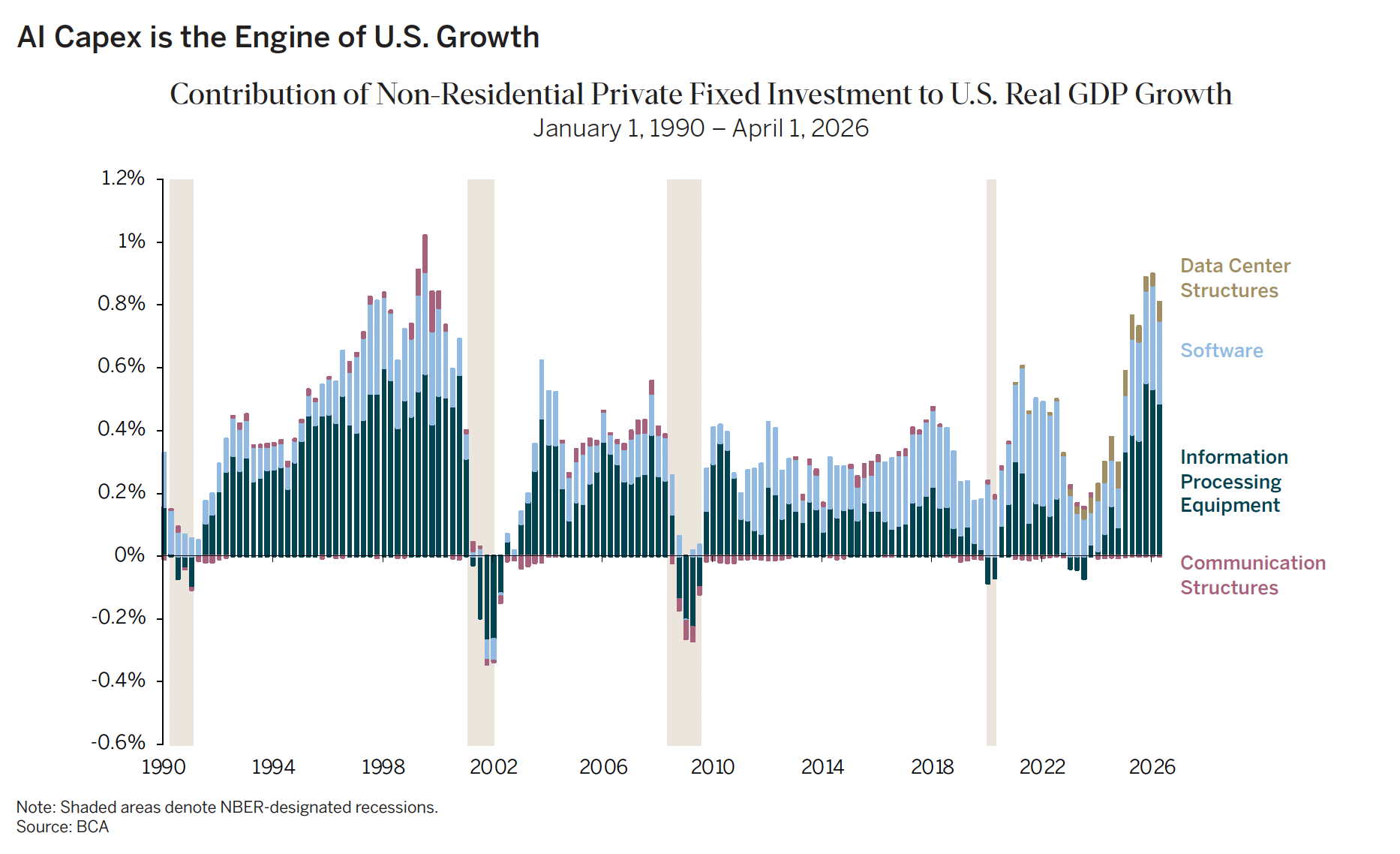
AI-related spending has also had significant indirect impacts on the U.S. economy.
- This year’s surge in company earnings and stock prices is buoying consumer spending. U.S. households currently hold $75 trillion in equities, equivalent to 230% of U.S. GDP. That’s well above the $13 trillion, or 130% of GDP, that households owned as the Internet bubble peaked in early 2000.
- Major U.S. investment banks have told investors that almost half of their capital market activities, in both fixed income and equities, is at least tangentially related to AI.
- Construction companies, utilities powering new data centers and industrial equipment makers are also benefitting from the very high levels of capital spending.
As a result of this spending boom and its spillover effects, analysts are exceedingly optimistic about long-term earnings growth.
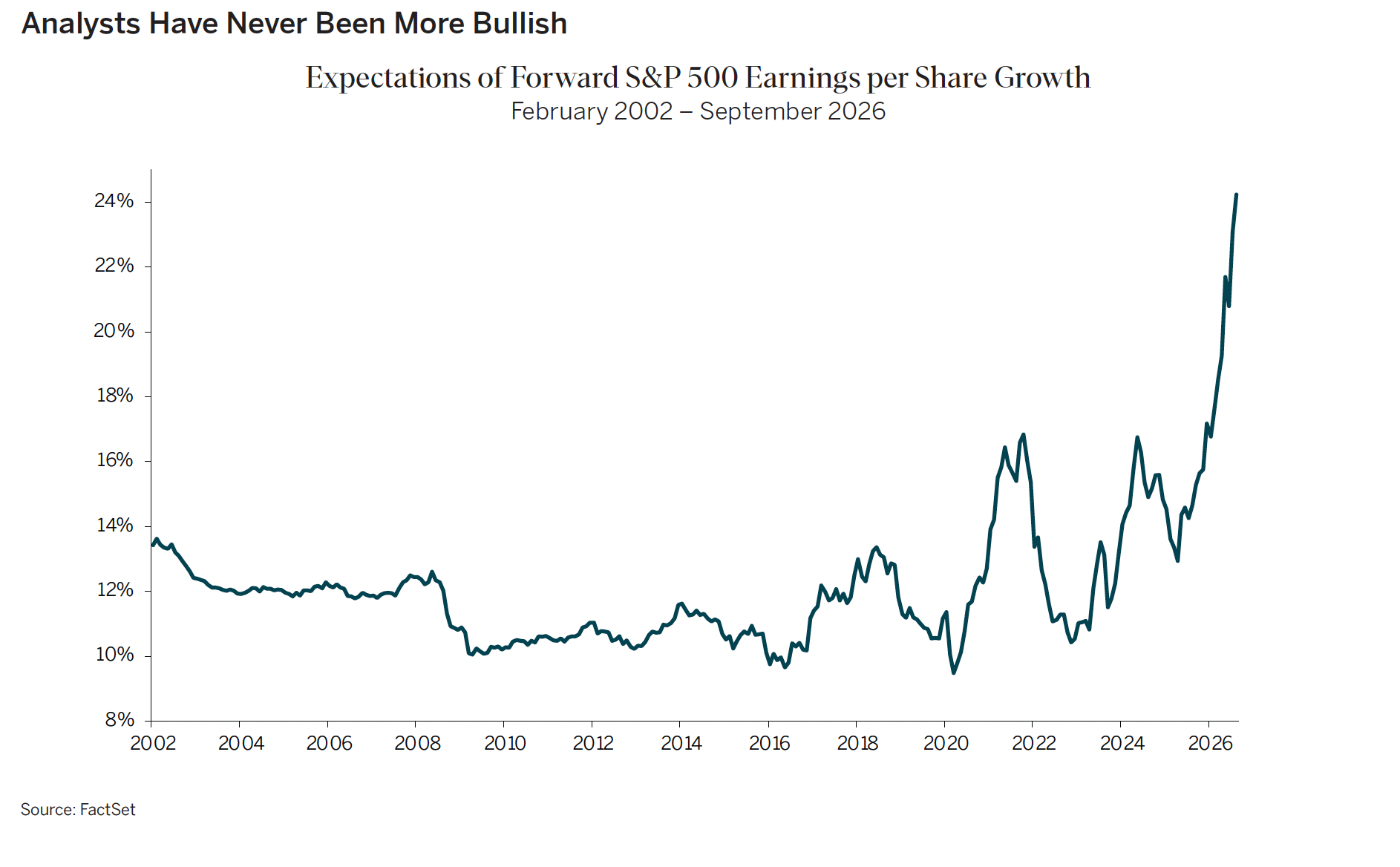
It appears that most analysts believe that the trillions of dollars being spent to build AI data centers will generate large enough profits in a short enough period of time to produce a large number of winners. But high expectations for earnings growth are not necessarily bullish indicators for future equity market returns. When expectations are high, the hurdle to beat them rises, increasing the risk of disappointment.
AI-related companies face a host of challenges. Public opposition to building data centers has soared, and even industry titans are advocating slower deployment, citing concerns about massive job losses and AI agents going rogue. AI and non-AI companies alike must now contend with higher interest rates as well as higher prices for oil and other commodities. Meanwhile, the tax and tariff refunds that boosted economic activity in the first half of the year are ending. It would not be surprising if earnings growth slows from today’s extraordinarily high levels.
KEEPING AN EYE ON TARGET ASSET ALLOCATION
Over the five years through September 2026, the S&P 500 has soared from roughly 4,300 to 7,700, delivering annualized returns, including dividends, of almost 14%. Over the same period, the Bloomberg U.S. Treasury Index declined by over 5%. With equities outperforming so massively, many long-term investors may have let their asset allocation tilt more heavily toward equities.
This decline in bond prices — and rise in yields — reflects both cyclical and secular forces. On the cyclical side, inflation remains sticky, owing to both supply constraints for oil, memory chips, fertilizer and other commodities, as well as demand pressures from a tight labor market and elevated business sentiment. On the secular side, persistent U.S. deficits and extraordinary corporate bond issuance to support the AI buildout have helped push rates higher than they have been for decades.
While bond yields could rise further, we believe that this may be an opportune time to consider increasing fixed income exposure to bring asset allocations closer to long-term targets.
A decision to rebalance must be made on a case-by-case basis. It can come at a cost. Rebalancing could generate taxable gains and means forgoing some gains if equities continue to outperform, but the risk-reduction benefits could be sizable. Investors who let their equity allocations swell unchecked during the Internet bubble saw steep losses when the bubble burst.
THEMATIC UPDATE
As we enter the fourth quarter, we are updating two of our newer investment themes where we see powerful secular changes underway. We are also pleased to share positive developments related to a third, longer-standing theme.
We introduced our End of Disinflationary Tailwinds theme in late 2020, when U.S. CPI was 1.3% and the price of oil was briefly negative. Since then, inflation soared to over 9%, retreated to 2.3% and then started to climb once again.
We added our Opportunities Abound Abroad theme in mid-2023, after the S&P 500 had outperformed the MSCI All Country World Index (ACWI) in 10 of the prior 14 years. The cumulative outperformance of the S&P 500 over that period was over 200%. Conversely, over the past two years, the MSCI ACWI has outperformed the S&P 500.
We are updating and renaming these themes to reflect our latest research and repositioning client portfolios for the consequential changes we foresee. With both the macroeconomic and geopolitical winds changing quickly, we would be surprised if we don’t continue to refine these themes in the quarters ahead.
End of Disinflationary Tailwinds evolves into Structural Supply Shortages
Our End of Disinflationary Tailwinds theme rested on several pillars. Many of them have come to pass or are now widely expected and thus reflected in market valuations. But we believe one pillar–the sustained shortage of capital spending on commodities-related infrastructure–will provide durable investment opportunities for several more years.
Over the past 10 years there have been relatively low levels of investment in commodities infrastructure. Since mines and offshore oil and gas projects can take many years to build, we expect the investment shortfall to cause shortages that drive up prices for key commodities. At the same time, we foresee steady demand growth for materials. Geopolitical concerns and relatively easy financial conditions around the world are boosting demand for redundant supply chains, higher baseline inventory levels, increased defense spending and electricity infrastructure. All of these initiatives are commodity intensive.
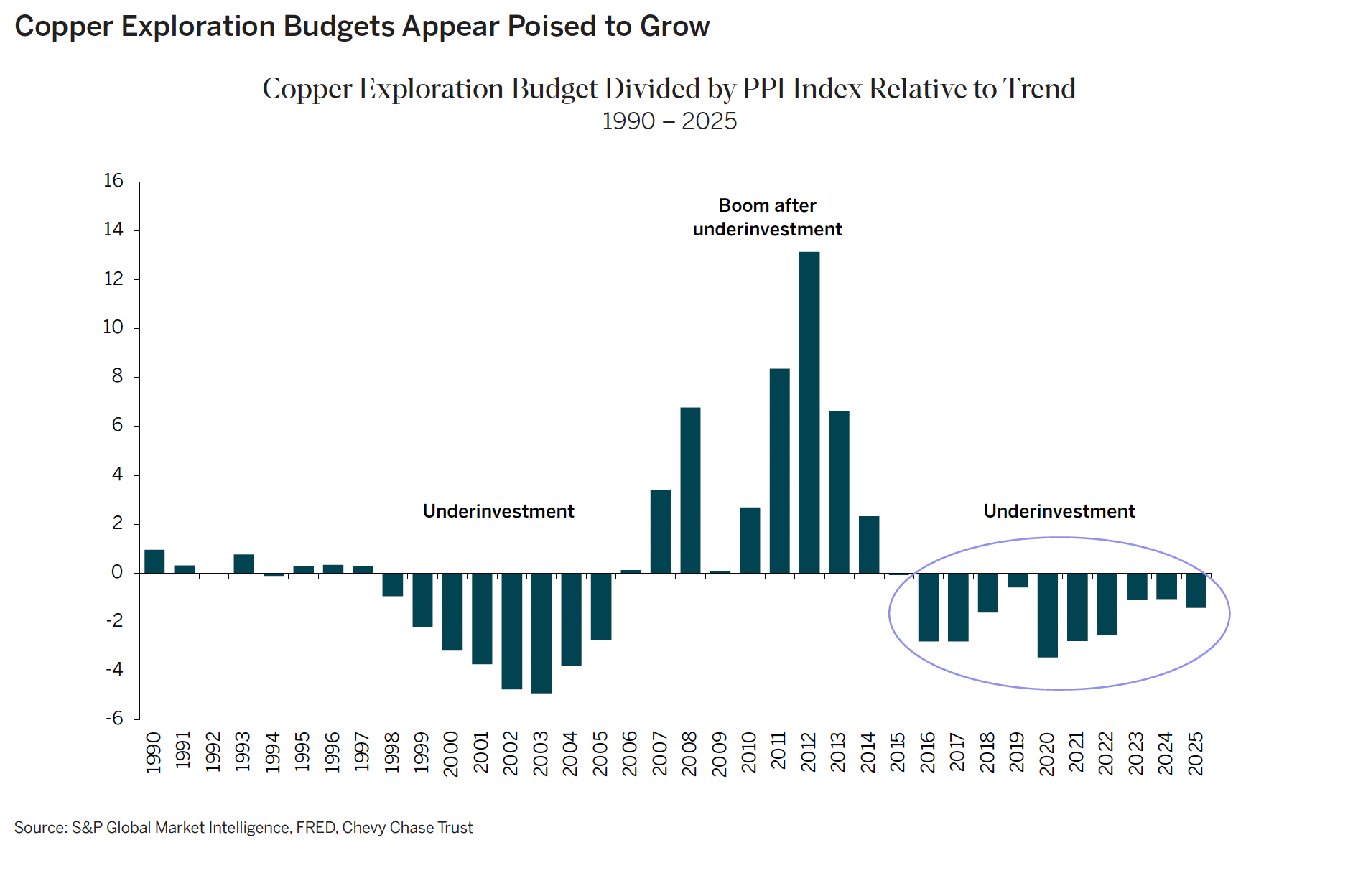
Commodity prices are already elevated. Higher prices lead to higher levels of capital spending. We believe spending on extracting and processing commodities will increase significantly over the next five to ten years. We expect to add exposure to commodity producers and to other companies positioned to take advantage of these trends in the quarters to come.
Opportunities Abound Abroad becoming Peaking Global Imbalances
The global economy is a series of equilibria: global supply is equal to global demand, debt somewhere is equal to a surplus elsewhere, exports from one country are equal to imports in others.
Over the past 30 years, several of these equilibria have become extremely skewed by region, as many Asian countries, most notably China and Japan, enacted policies that favored producers by keeping exchange rates low, encouraging corporations to invest in export capacity and consumers to maintain high levels of savings.
These policies made goods produced elsewhere cheaper for Americans to consume. U.S. producers could not profitably compete with foreign-sourced products, and many closed or moved production abroad.
From 1991 through 2026, the U.S. current account deficit (the value of U.S. exports and transfers minus U.S. imports and transfers) ballooned from a small surplus to a deficit of almost $1.1 trillion per year. Conversely, the combined annual current account surplus of China and Japan mushroomed from $13 billion to $950 billion.
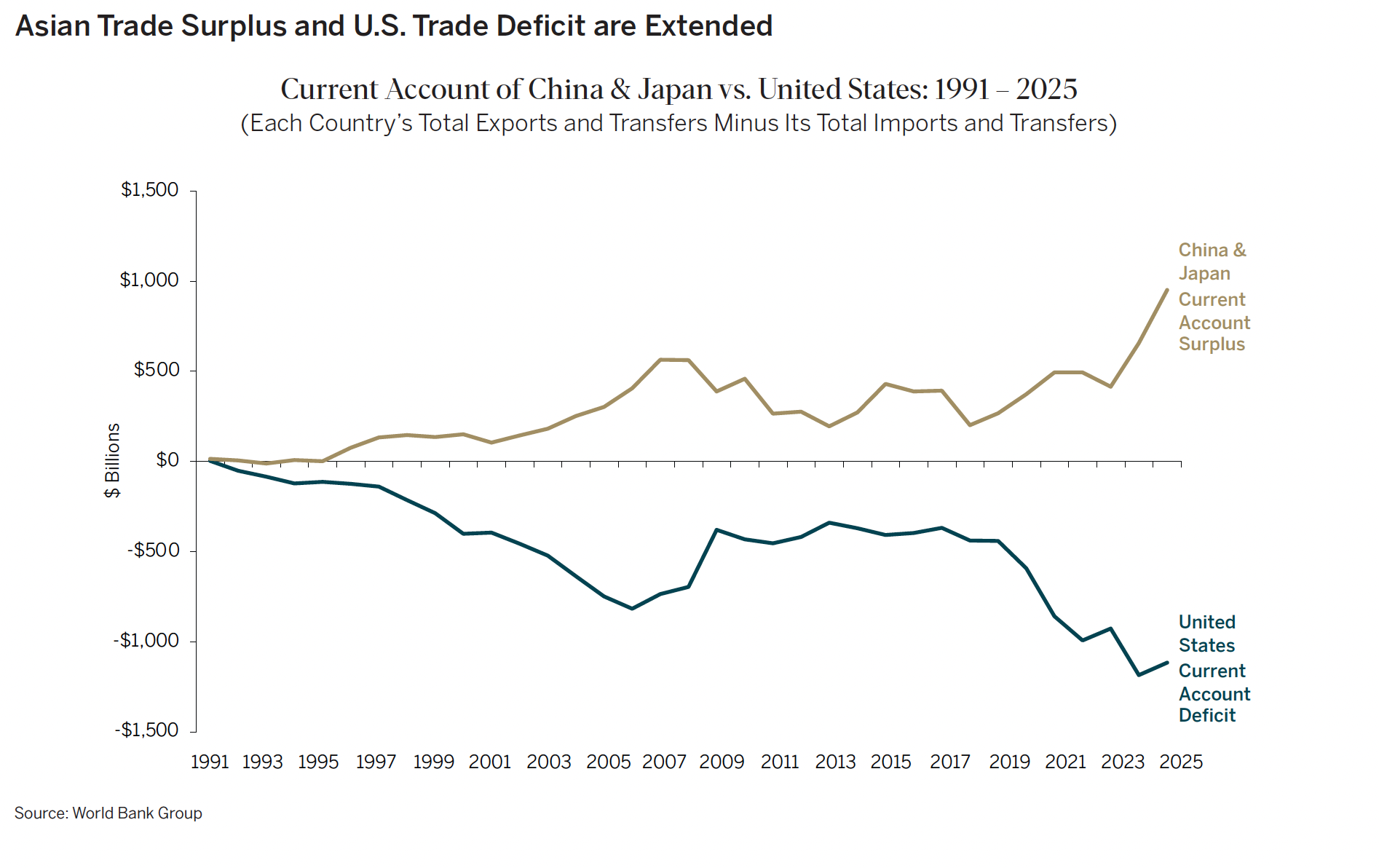
A large share of the dollars that U.S. consumers and companies sent abroad to buy foreign goods and services came back to the U.S. through purchases of U.S. equities and bonds, including Treasuries. For many years, non-U.S. investors garnered strong returns on these assets. The rise in the U.S. dollar compared to their home currencies further amplified their gains.
For a long time, these relationships benefited both sides. China built an astonishing industrial base and moved millions of people out of poverty. Japan was able to maintain a strong industrial base, despite extremely slow domestic GDP growth.
Cheap imports kept U.S. inflation low, which reduced borrowing costs and enabled the U.S. to run massive fiscal deficits. American investors also saw their wealth surge, as money poured into U.S. capital markets. Concerns about the hollowing out of the U.S. industrial base were allayed by relatively low unemployment, and many policymakers viewed the benefits as outweighing the costs.
But the shift of production to the East and the overspending in the West went too far. Shipping disruptions during the Covid pandemic and critical mineral shortages highlighted that offshoring production had reached a point where many essential goods were no longer produced domestically.
Over the past few years, the world has awakened to the risks posed by enormous imbalances in global trade. At the recent meeting of G20 finance leaders, every country except China called on countries with persistent external trade deficits to increase domestic savings and consolidate their fiscal positions.
While these trends may not yet have reached a tipping point, there are clear signs that a critical juncture is approaching.
- The U.S. is adopting policies to encourage domestic production, including tariffs, last year’s One Big Beautiful Bill Act (OBBBA) and the 2022 CHIPs Act.
- China is letting its currency, the renminbi, gradually appreciate, which will make its exports less attractively priced and imports more competitive.
- Japan is raising domestic interest rates for the first time in 31 years, which should help strengthen the yen.
Narrowing trade imbalances are likely to have widespread investment ramifications. Over time, we expect countries with large surpluses to spend more, save less and produce less. Conversely, countries with large deficits will likely spend less, save more and produce more. We expect to add exposure to companies likely to benefit from higher consumer spending in Asia and reduce exposure to companies overly reliant on rising U.S. consumer spending. A relatively weaker U.S. dollar may also eventually lead foreign investors to repatriate savings or look to other geographies and asset classes, such as gold, for their savings. In 2025, global central bank reserves held in gold surpassed foreign official holdings of U.S. Treasury securities.
Theme Update: Advent of Molecular Medicine
We would be remiss if we did not highlight truly astounding developments for our Advent of Molecular Medicine theme. During the third quarter, positive Phase 3 results were announced for the first-ever personalized cancer vaccine. Additionally, there were early indications that the FDA is likely to approve the first blood-based multi-cancer screening test, which uses genomic sequencing data to detect signs of cancer.
The central thesis of this theme, which we initiated more than a decade ago, is that the ability to read and understand genomic information would lead to medical breakthroughs. It is rewarding to see this coming to pass. We expect many more such developments in the coming years.
CONCLUSION
Throughout the first nine months of 2026, we believe we have navigated unpredictable geopolitical, economic and capital market shifts well, striking an appropriate balance between seizing opportunity and seeking protection. As always, we are grateful for the trust placed in us. We look forward to continuing to demonstrate that it is well placed.
Important Disclosures This commentary is for informational purposes only. The information set forth herein is of a general nature and does not address the circumstances of any particular individual or entity. You should not construe any information herein as legal, tax, investment, financial or other advice. Nothing contained herein constitutes a solicitation, recommendation, endorsement, or offer to buy or sell any securities or other financial instruments. This commentary includes forward-looking statements, and actual results could differ materially from the views expressed. Materials referenced that were published by outside sources are included for informational purposes only. These sources contain facts and statistics quoted that appear to be reliable, but they may be incomplete or condensed and we do not guarantee their accuracy. Fact and circumstances may be materially different between the time of publication and the present time. Clients with different investment objectives, allocation targets, tax considerations, brokers, account sizes, historical basis in the applicable securities or other considerations will typically be subject to differing investment allocation decisions, including the timing of purchases and sales of specific securities, all of which cause clients to achieve different investment returns. Past performance is not indicative of future results, and there can be no assurance that the future performance of any specific investment or investment strategy will be profitable, equal any historical performance level(s), be suitable for the portfolio or individual situation of any particular client, or otherwise prove successful. Investing involves risks, including the risk of loss of principal. The level of risk in a client’s portfolio will correspond to the risks of the underlying securities or other assets, which may decrease, sometimes rapidly or unpredictably, due to real or perceived adverse economic, political, or regulatory conditions, recessions, inflation, changes in interest or currency rates, lack of liquidity in the bond markets, the spread of infectious illness or other public health issues, armed conflict, trade disputes, sanctions or other government actions, or other general market conditions or factors. Actively managed portfolios are subject to management risk, which involves the chance that security selection or focus on securities in a particular style, market sector or group of companies will cause a portfolio to incur losses or underperform relative to benchmarks or other portfolios with similar investment objectives. Foreign investing involves special risks, including the potential for greater volatility and political, economic and currency risks. Please refer to Chevy Chase Trust’s Form ADV Part 2 Brochure, a copy of which is available upon request, for a more detailed description of the risks associated with Chevy Chase Trust’s investment strategy. The recipient assumes sole responsibility of evaluating the merits and risks associated with the use of any information herein before making any decisions based on such information.



